
The United Kingdom is home to six species of true tits: the great tit, blue tit, coal tit, marsh tit, willow tit, and crested tit. All are small, active songbirds, easily recognized by their compact build, curious behavior, and frequent visits to garden feeders.
This article focuses on the native and regularly occurring types of tits from the Paridae family found across the UK, including Great Britain (England, Scotland, and Wales) and Northern Ireland. We describe their appearance, habitat, and behavior to help you distinguish them in the field, with attention to the unique roles each species plays across different habitats and regions. We also briefly look at a few similar-looking or occasionally seen species that are sometimes mistaken for tits.
Great tit (Parus major)
- Description: Largest UK tit, with bold black-and-yellow plumage.
- Where found: Across the UK – in woodlands, gardens, and urban parks.
- Region status: Native resident; very common.
- Conservation: Least Concern; stable, highly adaptable.
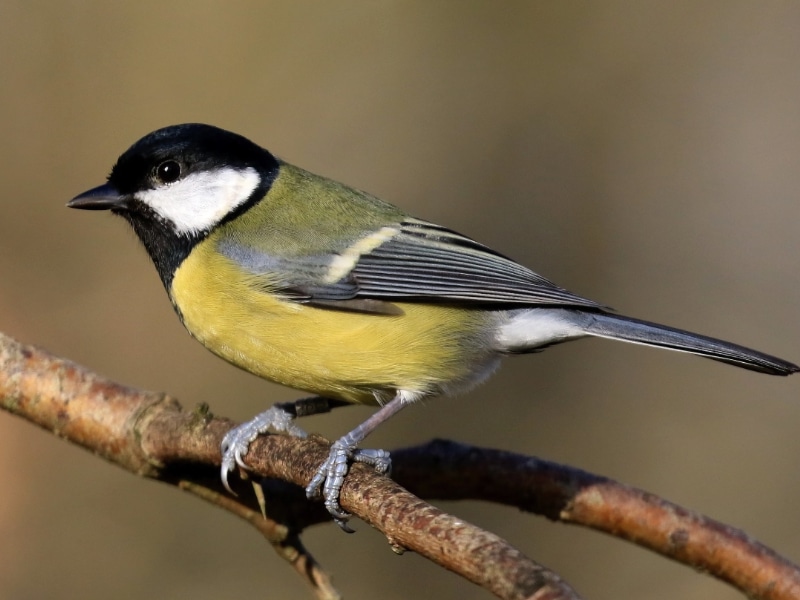
The great tit is the most widespread tit species in the UK, found year-round in a wide range of habitats from woodlands and hedgerows to city gardens. It is also the largest, measuring 12.5-15 centimeters (4.9 to 5.9 inches) in length. Bold and conspicuous, it has a black head with bright white cheeks, yellow underparts split by a black stripe, and olive upperparts tinged with blue. Males typically show brighter plumage and a broader chest stripe than females.
It is a highly vocal species with a broad and flexible song repertoire, including rhythmic two- or three-note calls. Its vocal behavior is context-sensitive and even includes song matching in territorial disputes and mobbing calls that vary with predator threat level.
Listen to the great tit call:
Adaptable in both behavior and diet, the great tit forages in trees, shrubs, and on the ground, shifting its feeding height with the seasons. It is primarily insectivorous during the breeding season, with caterpillars forming the bulk of its nestlings’ diet, and becomes more omnivorous in winter. Nests are built in tree holes, walls, or nest boxes. Pairs form monogamous seasonal bonds and defend territories in spring, but in winter they often join mixed-species flocks.
Though generally resilient, great tits are affected by harsh winters, habitat fragmentation, and phenological mismatches caused by climate change. Conservation measures like nest box schemes and winter feeding continue to support their success across the UK.
Eurasian blue tit (Cyanistes caeruleus)
- Description: Small, agile tit with bright yellow belly and blue crown.
- Where found: Widespread across UK – in woodlands, gardens, and parks.
- Region status: Native resident; very common.
- Conservation: Least Concern; stable population, sensitive to habitat quality.
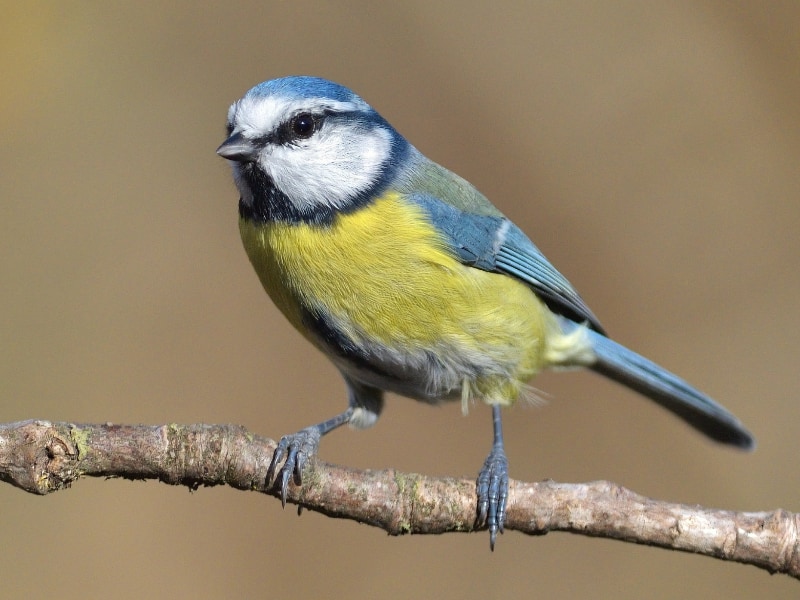
The Eurasian blue tit is a small, colorful songbird widely distributed throughout the UK, where it occupies deciduous woodlands, suburban parks, and garden feeders. Measuring 10.5-12 centimeters (4.1-4.7 inches) in length, it is easily recognized by its bright blue crown, white face with a dark eye-stripe, and yellow underparts with a hint of a dark belly line. Its back is greenish, and the wings and tail are tinged with blue and white. While males may be slightly more vibrant, both sexes are similar in size and plumage.
The species is vocal throughout the year, with males singing most intensively before and during the egg-laying period. Calls are highly context-specific and include whistles, trills, alarm notes, and mobbing signals directed at both aerial and ground predators.
Listen to the Eurasian blue tit call:
Blue tits are acrobatic foragers, often hanging upside down from twigs to reach insects. They breed in natural cavities or nest boxes, using moss and feathers to build their nests. The diet is highly seasonal, shifting from caterpillars and spiders in spring to seeds and berries in winter. Nestlings are fed a diet rich in moth and butterfly larvae, especially in oak-rich habitats. Outside the breeding season, blue tits join mixed-species flocks and display strong spatial awareness, learning and responding to alarm calls from other birds.
The species adapts well to urbanization but remains vulnerable to fluctuations in food availability, especially in caterpillar-poor habitats, as well as to nest-site competition with larger tits such as the great tit. While generally resilient, blue tits depend on high-quality habitat and seasonal synchrony for optimal breeding outcomes.
Coal tit (Periparus ater)
- Description: Small grey-and-black tit with white nape patch.
- Where found: Across UK – most common in coniferous woodlands and gardens.
- Region status: Native resident; widespread and fairly common.
- Conservation: Least Concern; stable population, some local declines due to pollution.
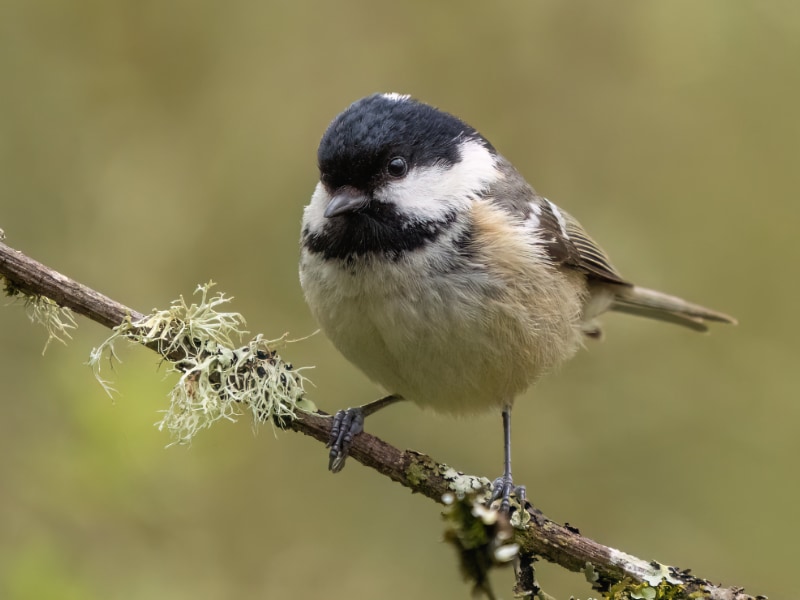
The coal tit is a compact, agile songbird found year-round across the UK, especially in coniferous woods, mixed forests, and well-vegetated gardens. It is the smallest of the UK’s resident tits, measuring 10-11.5 centimeters (3.9-4.5 inches) in length. Its plumage is more subdued than its relatives: a black cap, white cheeks, and a bold white patch on the back of the neck set against a grey back and buff-toned flanks. It shows two neat white wingbars and a slim, pointed bill adapted for feeding among conifer needles.
Though less showy, it is highly vocal, producing high-pitched “see-see” or “dee” calls, and a quick, repetitive song often heard from January through June. These calls help keep contact within winter flocks and signal territorial presence during spring.
Listen to the coal tit song:
Coal tits nest in tree stumps, burrows, or wall crevices, often using moss, hair, and feathers to insulate their deep nest cups. They feed on insects, seeds, and sap, and often store food in bark crevices for later use. During winter, they join roaming mixed-species flocks and are frequent visitors to garden feeders, especially where sunflower seeds or suet are available. Their foraging behavior includes hanging upside down and creeping along trunks, sometimes resembling treecreepers. While generally sedentary, some populations may shift altitudinally in harsh weather.
The species is resilient overall, though sensitive to pollution-induced insect declines in some parts of central Europe. In the UK, it remains a widespread and stable resident.
Marsh tit (Poecile palustris)
- Description: Greyish-brown tit with glossy black cap and small bib.
- Where found: Patchily across England and Wales – in old broadleaf woodlands.
- Region status: Native resident; local and declining.
- Conservation: Least Concern (global); nationally red-listed due to steep declines.

The marsh tit is a small, understated songbird of mature, moist deciduous woodlands, mainly found across England and Wales, with a patchy and declining distribution. It measures 11.5-12 centimeters (4.5-4.7 inches) in length, with a buff-toned belly, brown back, and a glossy black cap and bib. Its pale cheeks and lack of a wing panel help distinguish it from the similar willow tit.
The call is an explosive “pitchou” and the song varies widely, with some individuals having repertoires of five or more phrases, including high-pitched trills and rhythmic chip notes.
Listen to the marsh tit calls:
This species prefers oak and beech forests, especially those with a well-developed understorey, and is also found in old orchards and woodland edges with dense shrub layers. Marsh tits are cavity nesters, often using natural holes low in rotting stumps, walls, or the ground. Nests are made of moss, hair, and feathers. Pairs are monogamous and may remain together for life. The species feeds on insects, spiders, seeds, and fruit, and is an efficient food cacher, storing seeds in bark, moss, or leaf litter and retrieving them later with remarkable memory. Though sedentary year-round, individuals may join mixed tit flocks in winter.
While globally secure, UK populations have declined by over 50% since the 1970s, likely due to habitat fragmentation, understorey loss from deer browsing, and slow recolonization of restored woods. The species does poorly in areas dominated by other tit species and requires high-quality, continuous woodland to thrive.
Willow tit (Poecile montanus)
- Description: Sooty-capped tit with buff flanks and pale wing panel.
- Where found: Scattered across central and northern England – shrubby wetlands and young woodland.
- Region status: Native resident; highly localized and declining.
- Conservation: Least Concern (global); red-listed in the UK due to steep long-term declines.

The willow tit is a quiet, elusive resident of damp young woodland, willow scrub, and shrubby wetland edges, with its UK range is now limited mainly to parts of England. Measuring around 11.5 centimeters (4.5 in) in length, it has a soft brown back, buff-toned underparts, white cheeks, and a dull black cap that extends onto the neck. The small black bib appears untidy compared to the marsh tit’s, and the species can be separated in the field by its pale wing panel and subtly more rufous flanks.
Its call is a nasal “zee-zee-zee” or “ipsee-ipsee,” and its song, a slow, whistled trill, is distinctive but used sparingly. It favors scrubby woodland over mature forests and has lower tolerance for fragmentation, with very limited recolonization ability.
Listen to the willow tit calls:
Unlike the marsh tit, the willow tit excavates its own nest cavity, usually in rotting stumps, using felted material like fur and wood chips to line the nest cup. It feeds on insects, caterpillars, and seeds, caching food in crevices or bark for winter.
Though common across much of the Palearctic, UK numbers have plummeted by over 80% since the 1990s, largely due to habitat loss, competition for nest holes, and increased nest predation by great spotted woodpeckers (Dendrocopos major). It is among the UK’s most threatened resident birds, and conservation efforts now focus on protecting and connecting suitable habitat patches to support its remaining populations.
Crested tit (Lophophanes cristatus)
- Description: Distinctive small tit with black-and-white crest and bridled face.
- Where found: Restricted to ancient pine forests of northern Scotland.
- Region status: Native resident; rare and highly localized.
- Conservation: Least Concern (global); Schedule 1 listed in the UK due to restricted range.

The crested tit is an unmistakable resident of Scotland’s native pinewoods, confined almost entirely to the Caledonian forests of Strathspey and Inverness-shire. It measures 11.5-12 centimeters (4.5-4.7 inches) in length and is easily recognized by its upright black-and-white crest, pale face framed in black, and buffy-brown body.
Its song is a high-pitched bubbling trill, typically introduced by a few sharp notes, and its constant “zee zee zee” calls resemble those of the coal tit but are gentler in tone.
Listen to the crested tit calls:
The species often feeds at low to middle levels of the forest, searching for insects and pine seeds while clinging to trunks or hanging acrobatically from branches. Crested tits build their nests in cavities of decaying stumps or trees, lining them with moss, hair, and feathers. They are monogamous and often pair for life, with breeding beginning as early as March. During winter, individuals join mixed-species flocks and cache food for later use.
Although the species is widespread across continental Europe, UK populations are vulnerable due to their limited range, dependence on ancient woodland structure, and sensitivity to modern forestry practices. In Scotland, their fortunes are tied closely to the health and continuity of native pine forests.
Other tits and similar species in the UK
While the six tit types covered above represent all the true tits (family Paridae) that occur naturally and regularly in the United Kingdom, a few other birds may be mistaken for tits due to their size, behavior, or name.
The azure tit (Cyanistes cyanus) is one such species, an eastern relative of the blue tit, with a striking blue-and-white plumage. Although it has occasionally been reported in the UK, there are no confirmed wild occurrences, and all known records are considered likely escapees from captivity.
The long-tailed tit (Aegithalos caudatus) is a widespread native species that travels in noisy flocks and forages acrobatically like true tits. Despite the name, it belongs to a separate family (Aegithalidae) and is only distantly related.
Another bird that can, at a glance, resemble a very small tit is the goldcrest (Regulus regulus), especially when seen darting through conifers. At just 9 centimeters (3.5 inches) in length, it is the smallest bird in Europe and not related to the tits at all, belonging instead to the kinglet family (Regulidae). Its presence in mixed flocks and rapid, agile movements can lead to confusion with coal or crested tits in certain habitats.
Together, these species highlight the diversity of small, active woodland birds in the UK, and remind us that even familiar names and shapes can hide surprising evolutionary differences.